Beginner Workout Plan at Home: A Simple 4-Week Start (Free App)
The best beginner workout plan at home is not the hardest one you can find. It is the one you are still doing in week four. That means a short list of exercises, a schedule that fits around work and family, and a gentle starting point that leaves you feeling capable rather than wrecked.
This guide gives you exactly that: how to pick a starting plan, a simple four-week progression, a warm-up and cool-down, form and recovery basics, and the safety checks worth doing first. It is written to work with or without an app. Where a tool helps, we show how the free All Workout app handles it, since it was built for this situation.

Key takeaways
- Start with three full-body sessions a week, on non-consecutive days, around 30 to 40 minutes each.
- Weeks 1 to 3: lighter, controlled work at 3 sets of 16 reps. Week 4: slightly harder variations at 3 sets of 12.
- Learn each movement slowly before adding speed or weight. Slowing a demo to half speed helps.
- Warm up for five minutes, cool down for five, and rest 30 to 60 seconds between sets.
- If you have a heart condition, joint injury, are pregnant or have any doubt, check with a doctor before starting.
Before you start: a two-minute safety check
Exercise is safe for most people, but "most" is not "everyone". Before your first session, answer a few honest questions. Has a doctor ever said you have a heart condition? Do you get chest pain, dizziness or unusual breathlessness with activity? Are you pregnant, recovering from surgery, or managing a joint or back problem?
These are the kinds of questions in the PAR-Q (Physical Activity Readiness Questionnaire), a standard screening tool used by trainers. All Workout asks them during onboarding and flags when you should speak to a doctor first. If any answer is yes, get the all-clear before you begin. It is a short conversation that protects months of progress.
Good to know: this guide is general fitness information, not medical advice. Muscle tiredness and mild next-day soreness are normal. Sharp pain, joint pain, chest discomfort or feeling faint are not. Stop and get checked.
Choose your starting plan
For a first month at home, three types of plan make sense. Here is how to pick.
Full body, 3 times a week
The classic beginner choice. Every session works legs, push, pull and core, so missing one day doesn't leave a muscle group untouched.
Bodyweight, no equipment
Ideal if you own nothing but a mat, or travel often. Progress by slowing down, adding reps or moving to harder variations.
Core and abs
Short and focused. Best as an add-on after a full-body session, not as your whole routine.
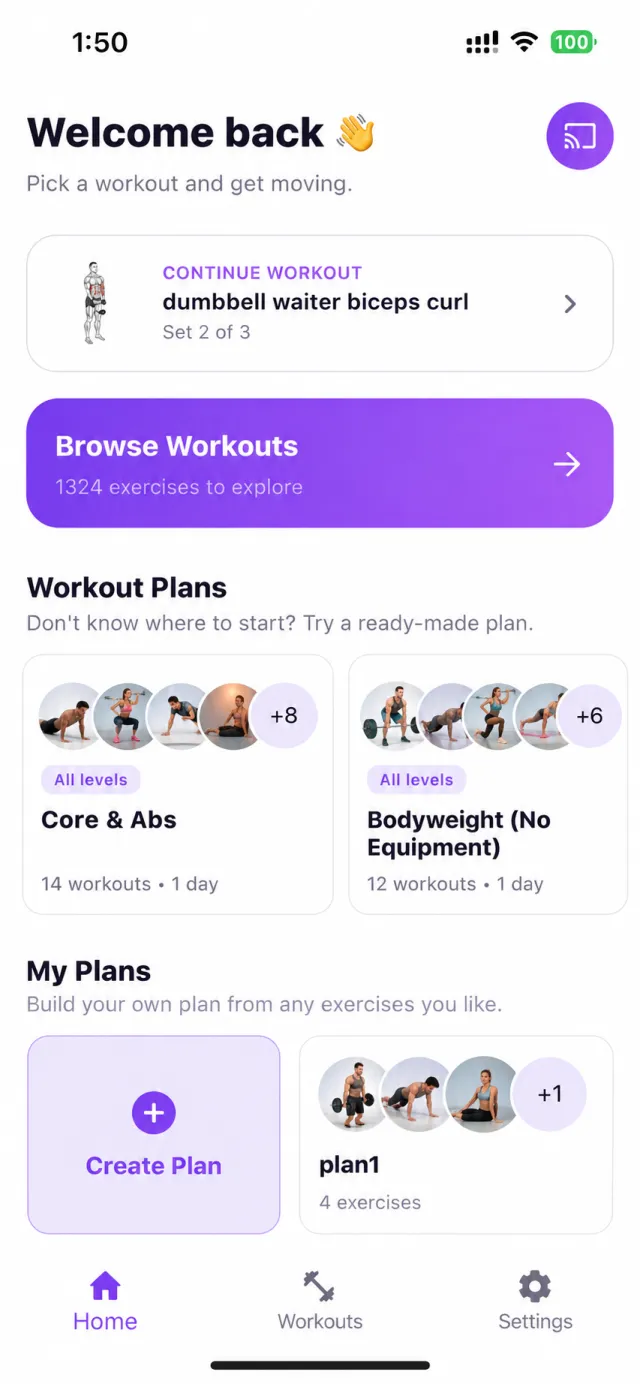
All Workout includes these as ready-made plans, alongside three for later. Here is the full set so you know where you are heading.
| Plan | Level | Schedule | Equipment | Pick it if… |
|---|---|---|---|---|
| Full Body | Beginner | 3 times a week | Varies by exercise; swap using filters | You are new and want the standard start |
| Bodyweight, No Equipment | All levels | Fits around your week | None | You have a mat and nothing else |
| Core & Abs | All levels | Add-on or short standalone | Varies by exercise | You want a focused trunk session |
| Push/Pull/Legs | Intermediate | Push, pull and leg days | Varies by exercise | You have trained consistently for a few months |
| Upper/Lower Split | Intermediate | Alternating upper and lower days | Varies by exercise | You want more volume per muscle |
| Body-Part Split | Advanced | 5 days a week | Varies by exercise | Training is already a firm habit |
A simple 4-week beginner workout plan at home
This progression borrows the logic of the first two phases of the NASM OPT model, which All Workout also uses: build control and endurance first with higher reps, then move to slightly more demanding work. Train on three non-consecutive days, for example Monday, Wednesday and Friday.
| Week | Sessions | Sets × reps | Focus |
|---|---|---|---|
| 1 | 2 to 3 | 2 × 16 | Learn each movement. Easiest variations, slow and controlled. |
| 2 | 3 | 3 × 16 | Same exercises, one extra set. Smooth, steady reps. |
| 3 | 3 | 3 × 16 | Slow the lowering phase to about three seconds per rep. |
| 4 | 3 | 3 × 12 | Step up the difficulty: a harder variation, a band or light dumbbells. |
Weeks 1 to 3 sit in Stabilisation Endurance territory (3 × 16), and week 4 moves to Strength Endurance (3 × 12). Fewer reps in week 4 is not less work: each rep should be harder.
A sample full-body session
This is the core of the beginner workout plan at home. Pick one exercise from each line. Start with the easier option and move right only when every rep looks clean.
- Squat: sit-to-stand from a chair → bodyweight squat → goblet squat holding a dumbbell.
- Push: wall push-up → incline push-up with hands on a sturdy table → knee push-up.
- Hinge: glute bridge → single-leg glute bridge → dumbbell Romanian deadlift.
- Pull: resistance band row → single-arm dumbbell row supported on a bench or chair.
- Lunge: split squat holding a wall → reverse lunge → walking lunge.
- Core: dead bug or bird dog → forearm plank, building up to 30 seconds.
Pro tip: if you can't finish the last set with good form, that is the right difficulty for now. If the last rep feels as easy as the first, move to the next variation next session.
Warm-up and cool-down: ten minutes that matter
A warm-up raises your body temperature and rehearses the movements you are about to do. A cool-down brings your heart rate down gradually. Neither needs to be complicated.
Five-minute warm-up
- March or jog on the spot (1 minute). Swing your arms naturally.
- Arm circles (30 seconds each way). Small circles growing larger.
- Hip hinges (10 reps). Hands on hips, push your hips back with a flat back.
- Half squats (10 reps). Shallow and easy, just a rehearsal.
- Step-back lunges (5 each leg). Slow, holding a wall if needed.
- One easy set of your first exercise. Half the reps, full attention on form.
Five-minute cool-down
Walk around for a minute or two, then hold a few gentle stretches for 20 to 30 seconds each: calves against a wall, the front of the thigh, hamstrings, chest in a doorway, and a child's pose for the back. Stretch to mild tension, never pain.
Learn the form first: slow it down
Beginners rarely get hurt by doing too little. They get hurt by doing a movement badly, quickly, many times. The fix is to learn each exercise slowly before you ever think about speed or load.

In All Workout, every one of the 1,324 exercises has an animated demo, and the player lets you set playback anywhere from 0.2× to 2×. A good routine for a new exercise:
- Watch two full reps at 0.5× and notice where the movement starts and ends.
- Do three practice reps with no weight, copying the speed of the demo.
- Check the cues: knees track over toes, back stays long, no shrugging into your ears.
- Only then start your working sets at normal speed.
Following on a TV makes this easier because you can see the demo without breaking position. Our All Workout guides cover how to put the demos on an Android TV.
Rest and recovery for beginners
Muscles adapt between sessions, not during them. That is why this plan uses non-consecutive days.
- Between sets: 30 to 60 seconds is plenty at these rep ranges. A rest countdown keeps you honest in both directions.
- Between sessions: at least one day off between full-body workouts. A walk on rest days helps more than it hurts.
- Soreness: stiffness a day or two after a new exercise is normal and fades as you adapt. Joint pain or sharp pain is a signal to stop.
- Sleep and food: regular sleep and enough protein across the day do more for progress than any extra set.
Let a workout plan generator build it for you
If choosing exercises feels like homework, use a plan generator. All Workout's Create My Plan asks two questions: your goal (General Fitness, Build Muscle, Lose Fat or Get Stronger) and your experience (Beginner, Intermediate or Advanced). It then builds a plan of up to eight exercises, one per muscle group.
Beginners always start in the Stabilisation Endurance phase, at 3 sets of 16, which lines up with weeks 2 and 3 of the plan above. The app logs every set as you go and pre-fills last session's numbers, so you can see week-on-week progress.


When week 4 arrives, use My Plans to build your own version from any of the 1,324 exercises, set each one to 3 × 12, and swap in harder variations. The equipment filter means you only see exercises you can actually do at home: tick body weight, band or dumbbell and ignore the machines.
Adding a core workout at home
Your core works in nearly every exercise above, especially planks, lunges and push-ups. A dedicated core session is a useful extra, not a replacement for full-body training.

Add 10 minutes of core work at the end of two of your three weekly sessions. Prioritise control over volume: a slow dead bug with your lower back gently pressed to the floor beats 50 rushed crunches. If you have back pain, keep to gentle, braced movements and ask a physiotherapist which ones suit you.
Common beginner mistakes to avoid
- Training every day in week one, then quitting by week two.
- Copying an advanced split before building the habit of three sessions a week.
- Rushing reps. If you can't pause at the bottom, you are going too fast.
- Skipping the warm-up because the workout "isn't that hard".
- Not writing anything down, so you can't tell whether you are improving.
- Judging progress by the scale alone. Track reps, form and how daily tasks feel too.
What to do after week four
If you finished four weeks, the habit is forming. From here you have three sensible paths:
- Repeat with harder variations. Keep 3 × 12, move each exercise one step along the list above, and keep logging.
- Let the app nudge you. When you complete all your sets for three sessions in a row, All Workout suggests adding reps (for example 12 to 14). Follow those prompts.
- Look ahead to a split. After a few consistent months, Upper/Lower or Push/Pull/Legs give each muscle more work.
Final thoughts
A good first month is boring in the best way: the same handful of movements, three days a week, done a little better each time. Start easier than your ego wants, learn the form slowly, rest properly, and write down what you did.
That is all a beginner workout plan at home really needs to be. Do it for four weeks and you will have something more valuable than a perfect plan: proof that you can stick to one. When you are ready for the next step, our home workout section has more.
Frequently asked questions
How many days a week should a beginner work out at home?
Three days a week is a sensible start for most beginners, on non-consecutive days such as Monday, Wednesday and Friday. That gives muscles a day to recover between full-body sessions while building a regular habit. A light walk on rest days is fine. Once three sessions feel routine for a couple of months, you can consider adding a fourth.
Can I build muscle at home without equipment?
Yes, especially as a beginner. Bodyweight exercises such as squats, push-up variations, lunges and glute bridges are enough to build strength for months if you keep making them harder: more reps, slower lowering, or tougher variations. A resistance band or a pair of dumbbells becomes useful later, when bodyweight versions start to feel easy.
How long should a beginner home workout be?
Around 30 to 40 minutes is plenty, including a five-minute warm-up and a five-minute cool-down. That leaves 20 to 30 minutes for five or six exercises of two or three sets each. Shorter sessions you actually complete beat long ones you dread. Even 20 minutes is worthwhile on a busy day.
Should I see a doctor before starting a workout plan?
Check with a doctor first if you have a heart condition, chest pain or dizziness with activity, high blood pressure, a joint or back problem, are pregnant, or are recovering from surgery or illness. The PAR-Q questionnaire, which All Workout asks during onboarding, is a quick way to spot whether you should get medical clearance before you start.
What is a workout plan generator?
A workout plan generator builds a routine from a few answers instead of you choosing every exercise. In All Workout, Create My Plan asks your goal and experience level, then builds a plan of up to eight exercises, one per muscle group, with sets and reps based on a simplified NASM OPT model. Beginners always start in the Stabilisation Endurance phase at 3 sets of 16.
How do I know when to make my workout harder?
Move on when you can complete every set with clean form and the last reps no longer feel challenging. Change one thing at a time: a harder variation, an extra set, or a little more weight. All Workout helps by suggesting more reps once you complete all your sets for three sessions in a row.
Start your 4-week plan tonight
All Workout gives you a beginner Full Body plan, a Bodyweight plan and a two-question plan builder, with slow-motion demos. Free, no account.
Get All WorkoutGet the TV app
Join the conversation